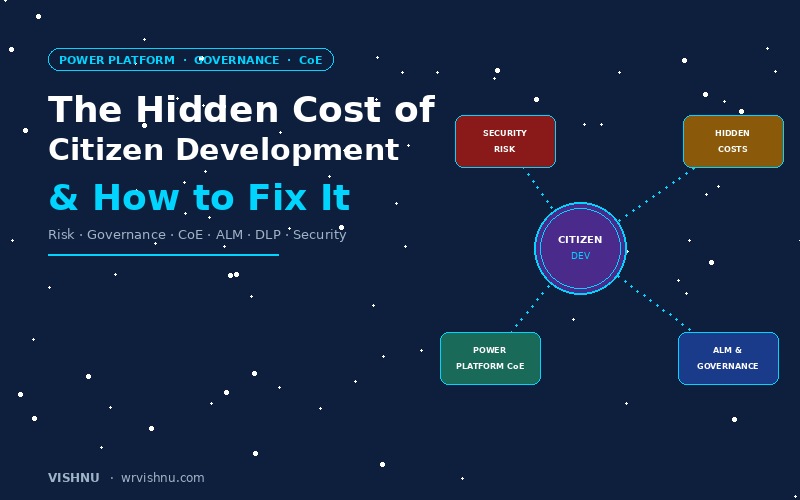
Citizen development promises faster delivery, a reduced IT backlog, and genuine business empowerment. And it delivers — at first. But beneath the speed and accessibility lies a layer of hidden costs most organizations never anticipate until they are already at scale.
In this post, we will break down exactly where those costs hide, why they accumulate, and how to build an enterprise-grade governance model that lets the practice scale without chaos. For Microsoft’s official guidance, see the Power Platform adoption methodology and the Center of Excellence Starter Kit documentation.
📋 Table of Contents
Executive Summary
Citizen development platforms like Power Platform promise three things:
|
⚡
Faster Delivery
|
📉
Reduced IT Backlog
|
🏢
Business Empowerment
|
The Reality
Citizen development shifts cost from development → governance, operations, and risk.
Without structure, it creates technical debt, security exposure, and fragmented architecture.
The Core Citizen Development Problem: Decentralized Innovation Without Control
Citizen development decentralizes software creation. That is its strength — and its biggest risk. When anyone can build, applications proliferate outside IT visibility, standards become inconsistent, and ownership evaporates.
|
What Happens
Apps built outside IT visibility. Inconsistent standards. No clear ownership. Shadow IT and uncontrolled app sprawl. |
The Result
Fragmented data, inconsistent security, and compliance risks that compound silently as the platform grows. |
Key Insight
Citizen development is not a tooling problem — it is an operating model problem.
The Hidden Citizen Development Cost Layers
Here is a deep analysis of where the real costs accumulate — seven layers that most organizations only discover when it is too late to address them cheaply.
1. Technical Debt Explosion
Citizen-built apps frequently duplicate logic, use inconsistent data models, and ship without documentation. Technical debt in low-code appears as invisible complexity — duplicated workflows and unmanaged dependencies that are hard to refactor, break at scale, and have no lifecycle owner.
Hidden cost: Rebuild instead of reuse · Increased maintenance overhead
2. Security & Compliance Risk
Citizen developers lack formal security training and may expose sensitive data unintentionally. Common issues include hardcoded credentials, open connectors, and poor access control — all of which can lead to data breaches and regulatory violations.
Hidden cost: Regulatory fines · Data breach impact · Loss of customer trust
3. Data Fragmentation & Poor Architecture
When apps are built independently without centralized data design, data silos form rapidly. Inconsistent reporting, duplicate data sources, and disconnected apps create fragmentation that undermines the business decisions the platform was meant to support.
Hidden cost: Wrong business decisions · Integration complexity later
4. Redundancy & Rework
Without visibility across teams and no reuse strategy in place, multiple groups independently build the same apps and workflows. The result is wasted development effort and inflated licensing consumption from redundant solutions.
Hidden cost: Wasted development effort · Increased licensing consumption
5. Scalability Failure
Apps that function perfectly at team level consistently fail when promoted to enterprise scale. Performance bottlenecks, poor architecture design, and the absence of environment strategy force expensive re-engineering and damage the platform’s internal credibility.
Hidden cost: Re-engineering at scale · Platform credibility loss
6. Operational & Support Burden
When bugs appear, enhancements are needed, or incidents strike — who owns the app? In most low-code environments, the honest answer is no one. IT inherits unmanaged applications, creating support chaos that consumes far more time than it would have cost to govern the apps properly from day one.
Hidden cost: IT inherits unmanaged apps · Support chaos and overhead
7. Organizational Complexity
Low-code platforms fundamentally change roles, responsibilities, and decision-making structures. This is consistently underrated. Scaling them requires organizational change, not just new tools — and governance overhead and training effort are real costs that must be budgeted.
Hidden cost: Governance overhead · Training and enablement effort
The Real Cost Shift
Citizen development does not reduce cost — it redistributes it into risk, governance, and operations.
Root Causes: Why Citizen Development Goes Wrong
|
Lack of Governance
No policies, no standards, no visibility. Without guardrails the platform grows in every direction simultaneously. |
Over-Focus on Speed
The “build fast” mindset sidelines architecture thinking, accumulating debt that slows everything down later. |
|
No Operating Model
Without defining who builds, who owns, and who approves — accountability disappears by default. |
Tool-First Approach
The platform is adopted before the strategy. Technology without process is just organized chaos. |
How to Fix Citizen Development Governance: Enterprise-Grade Approach
These eight steps form a proven framework for scaling citizen development with control — enabling innovation without abandoning governance.
1. Establish a Power Platform CoE
A Center of Excellence is the single most impactful fix. It defines standards, controls environments, enables reuse, and provides the organizational backbone that citizen development cannot function without at scale.
Research consistently supports the CoE as the critical foundation for scaling Power Platform governance.
2. Define an Environment Strategy
Separate environments by maturity and risk — not by team. A structured environment strategy prevents chaos and enables proper lifecycle control.
Dev — Citizen Test — Controlled Prod — IT-Managed
3. Implement DLP & Security Guardrails
Data Loss Prevention policies, connector restrictions, data classification, and role-based access control move the platform from open access to controlled freedom — citizen developers can still build, but within safe boundaries.
4. Introduce Application Tiering
Not all apps carry the same risk. Tiering ensures governance effort is proportionate to impact.
5. Standardize ALM (Application Lifecycle Management)
Version control, CI/CD pipelines, and solution packaging prevent broken deployments and untracked changes — the two most common failure modes when citizen-built apps graduate to production.
6. Create Reusable Architecture Patterns
Templates, shared components, and an API-first design approach reduce duplication by giving citizen developers building blocks that are already governed, tested, and secure. The result is faster development and less risk — simultaneously.
7. Implement Monitoring & Observability
Usage analytics, app health dashboards, and audit logs enable the critical shift from a build-first to an operate-first mindset. You cannot govern what you cannot see.
8. Enable Citizen Developers — Don’t Restrict Them
The goal of governance is not to slow people down — it is to give them the confidence to move faster. Provide training, templates, and guardrails. Modern governance should enable innovation, not block it.
Governance should enable, not block innovation.
The Future: Citizen Development + AI = Amplified Risk
With Copilot and AI-assisted development, apps will be built faster than ever before. Which means the risks will also scale faster than ever before.
|
AI-Generated Insecure Apps
Copilot writes code fast — not necessarily securely. |
Unverified Automation Logic
AI-built flows may behave unexpectedly at scale. |
Data Leakage via AI
Sensitive data exposed through AI prompts and connectors. |
Final Thought
Citizen development is not a shortcut to digital transformation.
It is a new enterprise architecture layer that must be governed like any other critical system — with strategy, standards, and the right operating model in place before scale, not after.
Related Reading on wrvishnu.com
If you found this citizen development governance guide useful, explore more related content: