A Shift in the Power Platform Governance Landscape?
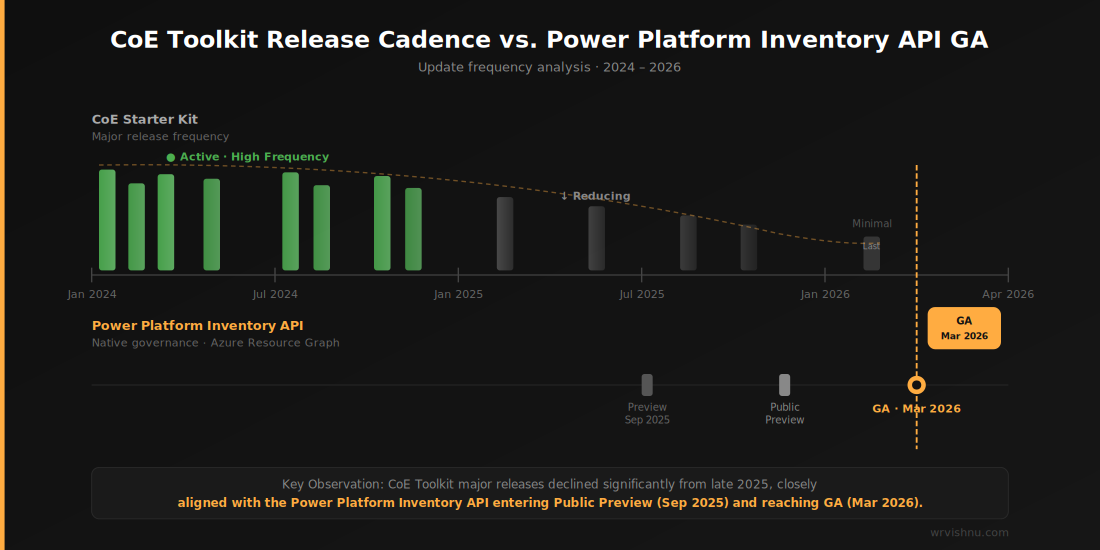
For years, Power Platform governance meant one thing: the Center of Excellence (CoE) Starter Kit. It was the gold standard, albeit a heavy one. But as we move into 2026, the Power Platform Inventory API is fundamentally changing that landscape—and a noticeable slowdown in major CoE updates since February 2026 is prompting architects to ask a sharper question: is the platform’s governance direction shifting for good?
The timing is hard to ignore. The Power Platform Inventory API reached General Availability (GA) in March 2026, closely aligned with the apparent reduction in CoE Toolkit release cadence. For Solutions Architects managing enterprise tenants, this is more than a coincidence; it signals a deliberate platform pivot toward native, high-performance governance capabilities.
This post explores what the Power Platform Inventory API offers, why it matters for enterprise governance in 2026, and how you can start using it today alongside—or potentially instead of—the CoE Toolkit.
What exactly is the Power Platform Inventory API?
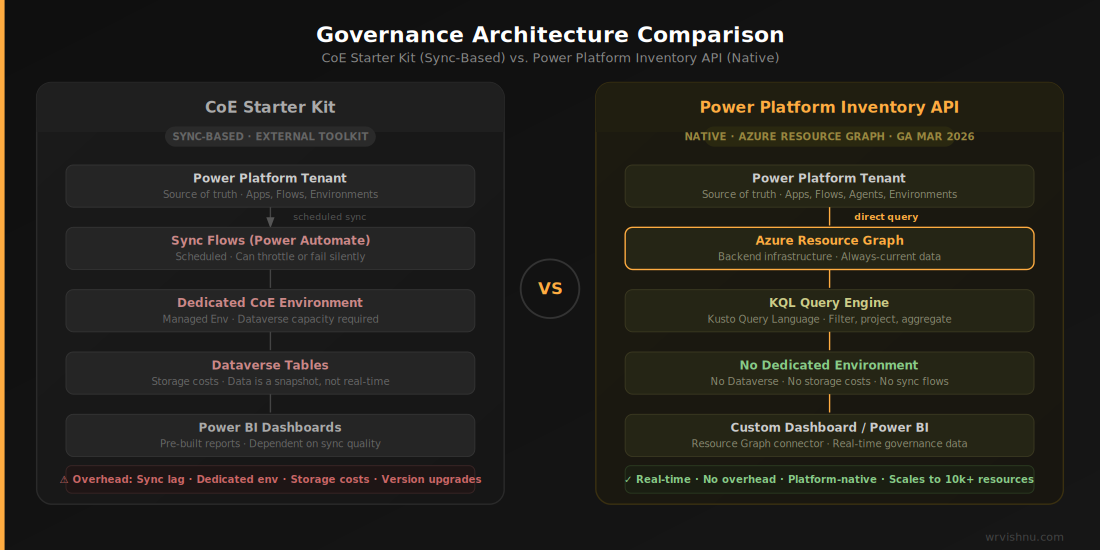
Think of the Inventory API as a direct line to the source of truth. It is a native Microsoft service that surfaces tenant-wide metadata like apps, flows, environments, and even AI agents via the Azure Resource Graph. Unlike the CoE Toolkit’s approach of “copy-pasting” data into a Dataverse environment through scheduled flows, the Inventory API queries resource state directly from Azure’s backend infrastructure.
This is a fundamentally different architecture. Rather than maintaining a parallel governance environment that mirrors your tenant, you’re querying the source of truth directly using Kusto Query Language (KQL) the same query language used across Azure Monitor and Microsoft Sentinel. For architects familiar with the Azure ecosystem, this is a natural fit. For those coming purely from a Power Platform background, it represents a meaningful upskilling opportunity.
Official reference: For the full GA announcement, see the Microsoft Power Platform March 2026 Feature Update.
Why the CoE Toolkit is starting to feel its age
Don’t get me wrong the CoE Starter Kit is a masterpiece of community engineering. But in a modern enterprise, it carries a lot of operational “baggage” that is becoming harder to justify:
- The Overhead: You must maintain a dedicated managed environment and set aside significant Dataverse capacity just to watch your other environments.
- The “Sync Lag”: We have all dealt with sync flows that throttle, fail silently, or just cannot keep up with a massive tenant during peak periods.
- The Maintenance Tax: Keeping the toolkit current is a job in itself. You end up “governing the governance tool” rather than focusing on actual strategy.
When you are dealing with tens of thousands of resources, the Dataverse storage costs alone can be non-trivial. This explains why a native, API-first alternative is so attractive for environments where operational simplicity is a priority. If you’re building from scratch, check out our foundational Power Platform architecture and governance articles.
Three Key Advantages for Enterprise Architects
1. Zero Operational “Noise”
Because the Power Platform Inventory API is served via Azure Resource Graph, there are no flows to monitor and no “governance footprint” to maintain. You query on demand and the data is live. It dramatically reduces the burden in regulated environments where every component must be patched and documented.
2. Speed at Scale
The API is built for the enterprise. Tenants with 50,000+ flows can be queried in seconds using KQL. There is no more waiting for the “overnight sync” to see if a new environment or resource has appeared in your governance view.
3. Day-Zero Support for New Features
Native tools evolve with the platform. When Microsoft ships a new resource—like the microsoft.powerplatform/copilotstudioagents we see in the 2026 schema—it appears in the API immediately. You don’t have to wait for a community release cycle to start tracking AI agent sprawl.
Exploring the 2026 Resource Schema
The Power Platform Inventory API’s 2026 schema provides visibility across the full platform estate:
| Resource Type | Governance Use Case | Native Support? |
|---|---|---|
microsoft.powerplatform/canvasapps |
App inventory and orphaned app detection | ✅ Yes |
microsoft.powerplatform/flows |
Flow audit and owner attribution | ✅ Yes |
microsoft.powerplatform/copilotstudioagents |
AI agent sprawl monitoring | ✅ Yes |
microsoft.powerplatform/managedenvironments |
Compliance and governance visibility | ✅ Yes |
The addition of copilotstudioagents is arguably the most significant addition for 2026. As organizations accelerate Copilot Studio deployments, having a control point to inventory agents by environment and owner is critical.
Sample KQL Query: Canvas App Inventory
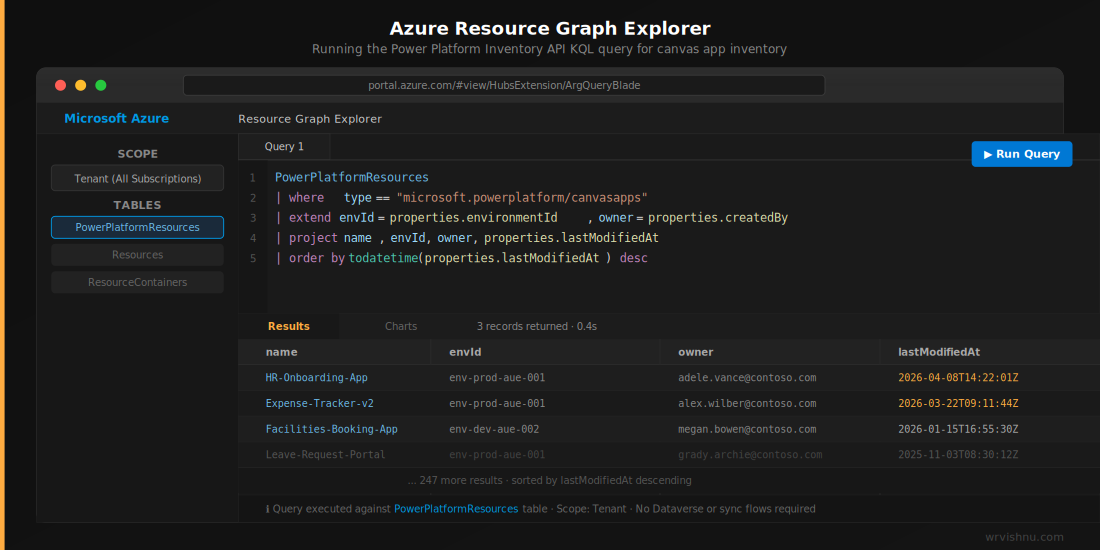
You can run this directly in the Azure Resource Graph Explorer to pull a tenant-wide inventory without needing any Dataverse storage:
PowerPlatformResources
| where type == "microsoft.powerplatform/canvasapps"
| extend envId = properties.environmentId, owner = properties.createdBy
| project name, envId, owner, properties.lastModifiedAt
| order by todatetime(properties.lastModifiedAt) desc
This is the foundation of a lightweight governance dashboard. From here, you can easily filter for resources that haven’t been touched in 90 days or cross-reference owners against Entra ID groups.
Strategic Outlook: The Agentic Center of Enablement
Microsoft’s 2026 Release Wave 1 points toward a clear vision: the Agentic Center of Enablement (planned for June 2026). This positions AI agents as active participants identifying orphaned resources and flagging policy violations natively. For architects, the signal is clear: Microsoft is building governance into the platform fabric, not on top of it. The Inventory API is the data engine that makes this possible.
CoE Toolkit vs. Inventory API: Which path should you take?
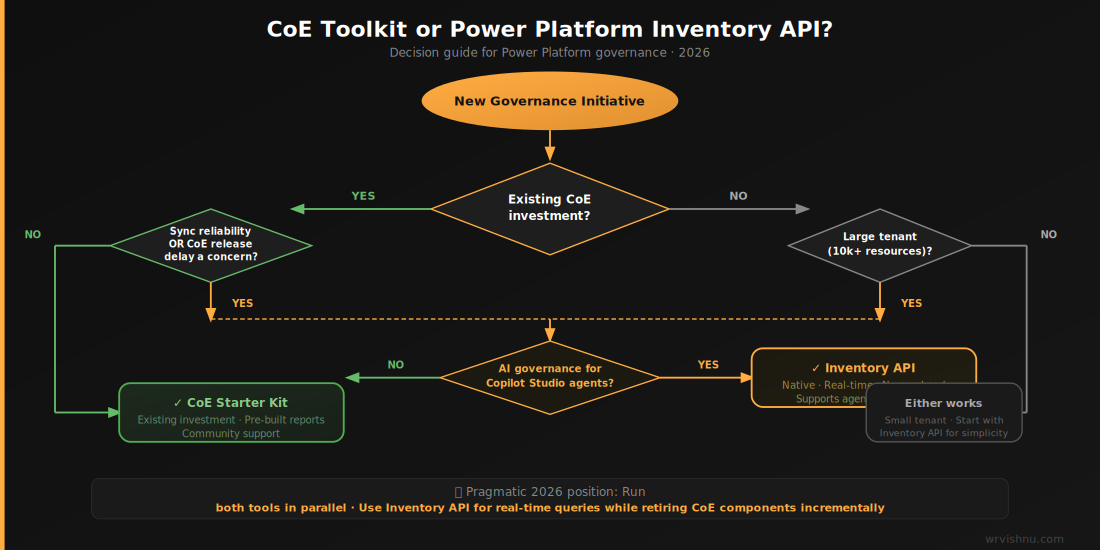
This isn’t necessarily a binary choice. Here is a pragmatic framing for 2026:
Stick with the CoE Toolkit if:
- Your team is already trained on its specific Power BI dashboards.
- You rely heavily on its pre-built environment request and approval flows.
- You need the community-driven customisation layer.
Evaluate the Inventory API if:
- You are starting a new governance initiative from scratch.
- You operate a massive tenant where CoE sync reliability is a constant headache.
- You want to build AI-specific governance controls for Copilot Studio.
The 2026 Playbook: Run both in parallel during a transition period. Use the Inventory API for your heavy data lifting and real-time queries, while retiring CoE components as native features mature.
Frequently Asked Questions
Is the Power Platform Inventory API free to use?
The API is a platform service. Querying via Azure Resource Graph usually doesn’t incur extra costs beyond your existing Microsoft 365 / Power Platform licenses.
Does the Inventory API replace the CoE Starter Kit?
Not officially. Microsoft has not deprecated the toolkit, but the shift in focus is clear. Architects should treat the Inventory API as the long-term “data layer” for their governance strategy.
Can I use the Inventory API data in Power BI?
Yes. You can connect Power BI directly to Azure Resource Graph. This bypasses the need for Dataverse as an intermediary store, making your dashboards much faster.
Key Takeaways for Architects
- The Power Platform Inventory API is the new native standard for resource visibility.
- It supports KQL querying across all major resource types, including the critical 2026 addition for Copilot Studio agents.
- The upcoming Agentic Center of Enablement reinforces that the future of governance is API-first and native.
Further Reading & Resources
- 📺 Power Platform Inventory API — Video Deep Dive (YouTube)
- 📖 Microsoft Learn — Power Platform Inventory API Schema Reference
Exploring Power Platform strategy? Browse more architecture content in the Power Platform category on wrvishnu.com.